

5 The Humanual · Volume 5 of 5 · the series
The Compass
The owner’s manual for a finite life.
The questions are fine. You are supposed to have them. Here is some company.

- 248 pages10 chapters and an appendix
- Three editionsPaperback $19.99 · Hardcover $29.99 · Ebook $9.99
- Out nowGood Work Press · 5.5 × 8.5 in
- ISBN979-8-952870-13-0 (paperback)

About this volume
Meaning, purpose, ethics and mortality
You understand your body, your mind, the people around you, and the systems those people built. One question remains, and it is the one the whole series has been circling since page one: what is any of this for?
The fifth and final volume asks why a survival machine generates a being that wonders about meaning, then lays out the menu of answers humans have come up with, treating each with respect and none with deference. Values you actually hold rather than the ones you were issued. Ethics without a rulebook. Purpose, work, creativity, play, and awe. Then the weight: suffering, aging, and the fact that you are going to die, treated not as problems to solve but as the conditions that make meaning urgent.
Gentler than the earlier volumes. No less funny.
Read the opening
Chapter 1, as it begins
Chapter 1
The Stage
Where You Are
You are on a rock.
The rock is moving. It is spinning on its axis at roughly 1,000 miles per hour (1,600 kilometers per hour), which you do not notice because everything you have ever known is spinning with you, including the atmosphere, which is polite enough to keep pace. The rock is also orbiting a star at approximately 67,000 miles per hour (107,000 kilometers per hour), which you also do not notice, because noticing would be extremely inconvenient and evolution saw no reason to install a speedometer. The star, in turn, is orbiting the center of a galaxy at roughly 515,000 miles per hour (828,000 kilometers per hour). The galaxy itself is hurtling through space at approximately 1.3 million miles per hour (2.1 million kilometers per hour) relative to the cosmic microwave background, which is the faint afterglow of the universe’s birth and which permeates all of space and which you can actually see, sort of, if you tune an old television to a dead channel: roughly 1 percent of the static is the echo of the Big Bang, arriving at your screen 13.8 billion years late, which makes it the longest commute in history.
You are, at this moment, sitting still, reading. You are also moving at a combined velocity that would be meaningless to calculate because it depends on what you are measuring it against, and in space, there is no fixed point to measure anything against, which is the kind of thing that sounds like a problem with the measurement but is actually a description of reality, and the difference between those two is the difference between physics and common sense, and physics, when the two disagree, is always right and never reassuring.
Four volumes have documented what you are: a body, a mind, a social animal, a citizen of systems built by other social animals. None of those volumes mentioned where all of this is happening. This chapter corrects the omission. It is a considerable omission. The stage, it turns out, is slightly larger than the play.
From the book
Frequently Panicked Questions
Every chapter ends with the questions people are too embarrassed or too frightened to ask out loud. These are from Chapter 1.
Does the size of the universe mean nothing matters?
This is the question the rest of the volume exists to address, and the short answer is: size has no relationship to significance. A love letter is not less meaningful because the ocean is large. A symphony is not less beautiful because the composer will die. The feeling of smallness is real, and taking it seriously is the beginning of genuine philosophical inquiry, not the end of it. The vertigo you feel when contemplating the scale of the universe is the same vertigo that has produced every significant philosophical and religious tradition in human history. You are in good company. The company includes everyone who has ever looked up.
What was before the Big Bang?
Current physics cannot answer this, and the question may not be well-formed. “Before” requires time. Time, as best we can determine, began with the Big Bang. Asking what happened before time is like asking what is north of the North Pole: the question uses a framework that does not apply in the territory it is asking about. This is one of the hardest questions in science, and the honest answer is “we do not know,” which is, for a species that dislikes not knowing, one of the most valuable things to sit with.
Are we alone?
We do not know. Both answers are profound. If we are alone, we are the only point in 2 trillion galaxies where the universe became aware of itself, which is a responsibility so large that the word “responsibility” seems inadequate. If we are not alone, we are part of a community so vast that the word “community” seems equally inadequate. The question is open. The silence is real. The search continues. And the search, regardless of what it finds, is one of the more admirable things humans have done with their fourteen seconds.
Should I be worried about the heat death of the universe?
No. It is projected to occur in approximately 10100 years, which is a number so large that it contains more zeros than there are atoms in the observable universe. You have more immediate concerns. The heat death of the universe is the least urgent item on your to-do list, and your to-do list almost certainly contains several items that are considerably more overdue and more actionable. Attend to those first. The universe will wait. It is, if nothing else, patient.
What if the universe just deletes itself without warning?
You have likely encountered the concept of vacuum decay, possibly while scrolling the internet at a time you should have been sleeping. The theory suggests that the quantum fields underlying reality may not be in their most stable configuration but rather in a “false vacuum,” and that if any point in the universe were to accidentally drop to a lower energy state, it would create a bubble of altered physics expanding outward at the speed of light, disintegrating every atom it touched. This is a real hypothesis. It is also, from a practical standpoint, irrelevant. Current models suggest that if vacuum decay is going to happen, it is not expected for approximately 10100 years. More to the point, the bubble travels at the speed of light, which means you would never see it coming. Your nervous system operates at a fraction of that speed. You would simply cease to exist before the signal of your destruction reached your visual cortex. There would be no pain, no panic, and no time to regret not eating more carbohydrates. Worrying about vacuum decay is the cognitive equivalent of worrying about whether the concept of mathematics is secretly plotting against you: an impressive use of imagination that accomplishes absolutely nothing.
Read all 26 Frequently Panicked Questions from this volume
Text from the first edition. General information with jokes in it, not medical, psychological, legal or financial advice.
Contents
10 chapters and an appendix
- The StageWhere You Are
- The QuestionWhy?
- The MenuFrameworks for Meaning
- The Compass You BuildValues
- The NavigationEthics Without Dogma
- The SearchPurpose, Work & Vocation
- The Full ExperienceCreativity, Play, Awe & Joy
- The WeightSuffering, Mortality & What They Teach
- The Long ViewLegacy, Aging & Being a Good Ancestor
- A Final MessageA Letter from the Manual
- Appendix AThe Compass Quick Reference
Formats and prices
Where to get it
On sale now in paperback, hardcover and ebook. Buy from any of these shops, or ask your local bookshop to order it by ISBN.
- Paperback$19.99 · 248 pp
ISBN 979-8-952870-13-0Buy on Amazon - Hardcover$29.99 · case laminate
ISBN 979-8-952870-12-3Buy on Amazon - Ebook$9.99 · EPUB and Kindle
ISBN 979-8-952870-14-7Buy on Amazon
The other four
The Humanual is five volumes. Each stands alone.
 1. The HardwareYour Body
 2. The Operating SystemYour Mind
 3. The PassengersOther People
 4. The MapYour World
All five volumes, ISBNs and the launch note → · The Toolkit: the practical pages, kept current →
Merchandise. We apologize.
Factory labels for the unit
Shirts, a hat, mugs and stickers that say what the books say, out loud, in public. Every fact on them was checked.
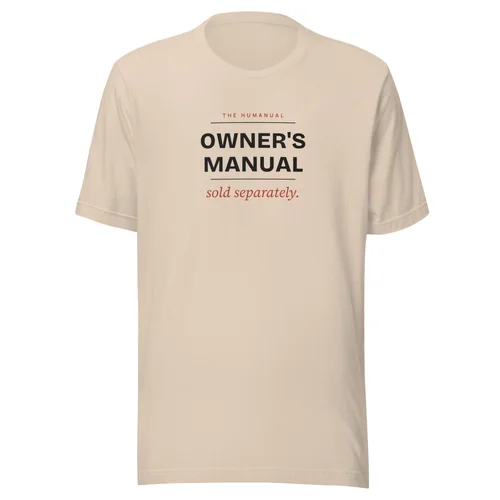 Owner's Manual tee$29
 Contents May Shift tee$29
 Owner's Manual dad hat$30
 Gravity mug$24
 FPQ mug$24
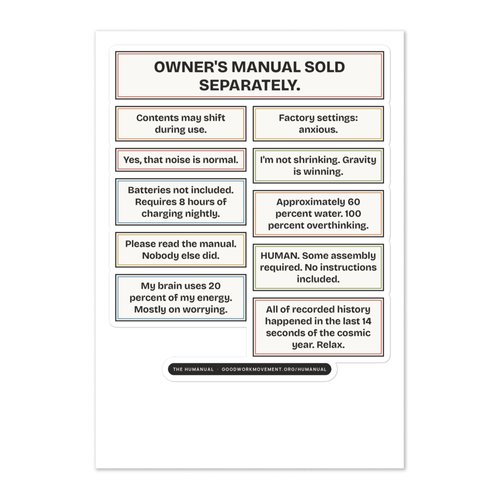 Sticker sheet$10
Printed on demand by Printful, one at a time.