

1 The Humanual · Volume 1 of 5 · the series
The Hardware
The owner’s manual for your body.
Two dollars’ worth of minerals, currently reading this sentence.

- 416 pages18 chapters and 4 appendices
- Three editionsPaperback $19.99 · Hardcover $29.99 · Ebook $9.99
- Out nowGood Work Press · 5.5 × 8.5 in
- ISBN979-8-952870-01-7 (paperback)

About this volume
What is in it
Congratulations. You have been issued a body. It arrived without paperwork, it cannot be returned, and roughly 60 percent of it is the same substance that fills puddles. Nobody handed you the manual.
This is the manual. One system at a time: the frame designed for walking and now mostly folded into chairs, the engine room that beats a hundred thousand times a day without being asked, the defense network that will occasionally declare war on a peanut, the wiring that runs the whole operation on one unbacked-up cable, and the shutdown sequence you keep trying to skip.
How each part works. How it fails. What the evidence says about looking after it. Which of the things you were told are myths. Every chapter closes with practical maintenance and a set of Frequently Panicked Questions.
Read the opening
Chapter 1, as it begins
Chapter 1
Welcome to Your Body
A General Orientation
Congratulations. You have been issued a body.
It is approximately 5 to 6.5 feet (2 meters) tall, depending on several factors outside your control. It is composed primarily of water (roughly 60 percent of you, by weight, is the same substance that fills puddles). The remainder is a complex arrangement of carbon, calcium, iron, and a few dozen other elements, none of which are particularly rare or expensive. The raw materials that comprise you, if separated and sold at market rates, would be worth somewhere between one and two dollars. Possibly less, depending on the economy.
This is, by any measure, an extraordinary return on investment. Because those two dollars’ worth of chemicals are currently reading this sentence. They are thinking about this sentence. They are, at this very moment, having an experience of being a conscious entity contemplating its own composition, which is, and we cannot stress this enough, an almost impossibly unlikely thing for two dollars’ worth of minerals to be doing. A puddle has never once done this. You are a puddle that woke up.
You are a collection of approximately 37 trillion cells, each one performing its own specialized function, organized into systems of staggering complexity, all of which are somehow coordinating with one another to keep you upright, breathing, and wondering what to have for lunch. These cells are piloting a skeleton wrapped in muscle wrapped in skin through a thin shell of breathable gas clinging to the surface of a rock that is hurtling through space at 67,000 miles (108,000 kilometers) per hour while simultaneously spinning and orbiting a ball of nuclear fire.
No documentation was included.
This is the documentation.
From the book
Frequently Panicked Questions
Every chapter ends with the questions people are too embarrassed or too frightened to ask out loud. These are from Chapter 1.
Is it normal that my body makes this sound?
Almost certainly, yes. Your body is an active, working system, a factory that never closes. It gurgles (digestion), clicks (joints), creaks (tendons and ligaments), thumps (your heart, doing its job), whistles (air through nasal passages), and produces a variety of other sounds that can alarm you if you encounter them in a quiet room at 2 a.m. The vast majority of these noises are the sounds of normal operation. They are your body’s version of an engine idling. A sudden, new, painful, or particularly alarming sound may warrant investigation, but in general: you are a noisy machine. This is fine.
Am I supposed to know what all of these parts are called?
Ideally, yes. You live inside this body. It is the only one you will receive. Knowing what the major components are called and what they do is roughly as important as knowing which pedal is the brake and which is the accelerator. It is, arguably, more important, since the consequences of confusion are more personally significant. If you do not currently know the difference between your liver and your kidneys, or where exactly your pancreas is and what it does, that is not your fault. It is a gap in your education that this manual exists to fill. By the end of this volume, you will know. You may not remember all of it, but you will have been told, and that is more than most people can say.
How breakable am I?
More than you would like. Less than you fear. The honest answer is: it depends enormously on context. Your body is capable of astonishing feats of endurance and recovery. People have survived falls from airplanes, weeks lost at sea, and conditions that would destroy most machinery within hours. At the same time, a fall from a modest height, a small blood clot in the wrong place, or an encounter with an organism too small to see can end you. You are neither fragile nor invincible. You are resilient within limits, and one of the purposes of this manual is to help you understand where those limits are.
Should I be worried about [that thing my body just did]?
This is, statistically, the question that drives more late-night internet searches than almost any other. And the honest answer is: usually no, sometimes maybe, occasionally yes. The human body does a great many things that feel alarming but are perfectly normal, twitches, pains, odd sensations, unexpected noises, mysterious marks. It also occasionally produces signals that genuinely warrant attention. We cannot give you a single answer that covers every situation, but we can give you something better: throughout this manual, we will equip you with the frameworks to distinguish the former from the latter. The goal is not to make you anxious about every twinge. It is to make you a competent reader of your own body’s signals, so you can respond with appropriate calm or appropriate urgency.
Is it too late to start taking care of this thing?
No. It is very nearly never too late. Your body has an extraordinary capacity for recovery and adaptation, even after years of neglect. Hearts strengthen. Lungs clear. Muscles rebuild. Brains form new connections. The science on this is clear and, frankly, encouraging: meaningful improvements in health and function are possible at virtually every age and from virtually every starting point. The best time to start was years ago. The second-best time is now. This is not a platitude. It is a well-supported observation about the biology of the machine you are sitting in.
Read all 93 Frequently Panicked Questions from this volume
Text from the first edition. General information with jokes in it, not medical, psychological, legal or financial advice.
Contents
18 chapters and 4 appendices
- Welcome to Your BodyA General Orientation
- The FrameYour Skeletal & Muscular Systems
- The Engine RoomYour Cardiovascular & Respiratory Systems
- The Processing PlantYour Digestive System
- The MessengersYour Endocrine System
- The Defense NetworkYour Immune System
- The WiringYour Nervous System
- The SensorsYour Senses
- The WrapperYour Skin, Hair, and Nails
- The Filtration PlantYour Kidneys and Urinary System
- The Continuation DepartmentYour Reproductive System
- The Moving PartsExercise and Physical Activity
- The Shutdown SequenceSleep
- Surface MaintenanceHygiene and Preventive Care
- When Things Go WrongIllness, Injury, and the Art of Being a Patient
- What You Put in the TankSubstances and Your Chemistry
- The Warranty ExpiresAging
- The Vehicle Is Not PermanentDeath
- Appendix AThe Body’s Dashboard
- Appendix BThe Maintenance Schedule
- Appendix CEmergency Quick Reference
- Appendix DGlossary of Parts
Formats and prices
Where to get it
On sale now in hardcover, paperback and ebook. The hardcover is the one built to be given. Buy from any of these shops, or ask your local bookshop to order it by ISBN.
- Hardcover$29.99 · case laminate
ISBN 979-8-952870-00-0Buy on Amazon - Paperback$19.99 · 416 pp
ISBN 979-8-952870-01-7Buy on Amazon - Ebook$9.99 · EPUB and Kindle
ISBN 979-8-952870-02-4Buy on Amazon
The other four
The Humanual is five volumes. Each stands alone.
 2. The Operating SystemYour Mind
 3. The PassengersOther People
 4. The MapYour World
 5. The CompassYour Meaning
All five volumes, ISBNs and the launch note → · The Toolkit: the practical pages, kept current →
Merchandise. We apologize.
Factory labels for the unit
Shirts, a hat, mugs and stickers that say what the books say, out loud, in public. Every fact on them was checked.
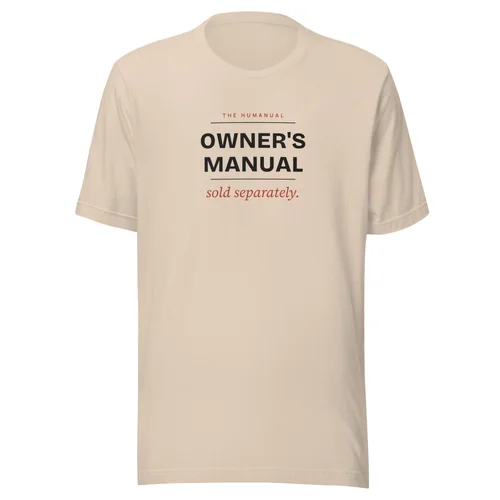 Owner's Manual tee$29
 Contents May Shift tee$29
 Owner's Manual dad hat$30
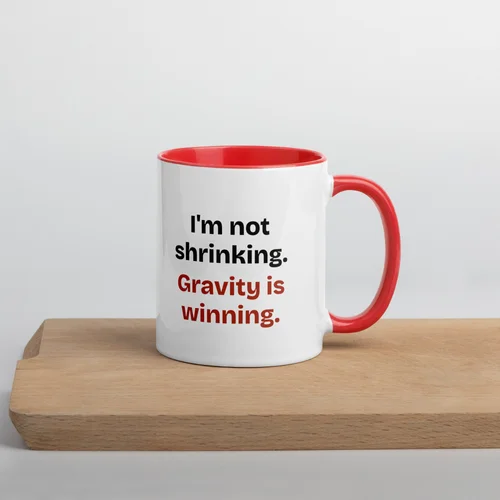 Gravity mug$24
 FPQ mug$24
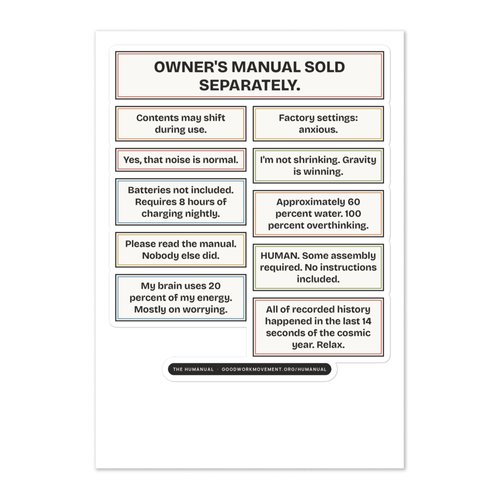 Sticker sheet$10
Printed on demand by Printful, one at a time.