

2 The Humanual · Volume 2 of 5 · the series
The Operating System
The owner’s manual for your mind.
There is a reason you did that. It is in here.

- 268 pages13 chapters and 2 appendices
- Three editionsPaperback $19.99 · Hardcover $29.99 · Ebook $9.99
- Out nowGood Work Press · 5.5 × 8.5 in
- ISBN979-8-952870-04-8 (paperback)

About this volume
Consciousness, emotion, memory, attention, sleep and the known bugs
The hardware came with software. Nobody told you that either.
This volume is about the three pounds of electrified fat currently reading this sentence and quietly congratulating itself. What the mind is doing when it feels, remembers, pays attention, wants things, sleeps, tells itself stories, and occasionally crashes. The known bugs every human ships with. The unreliable storage. The scarcest resource, and everyone who is trying to buy it. The ancient code you inherited from ancestors who had excellent reasons to fear the dark.
What science has settled, what it has not, and the myths you can now stop believing. It ends with a user manual for your own mind, assembled from everything before it.
Read the opening
Chapter 1, as it begins
Chapter 1
The Hard Problem
Welcome to Consciousness
Something is happening inside your head that should not be possible.
Not thinking. Thinking is impressive, certainly, but thinking is what you would expect a sufficiently complex biological computer to do, in the same way that you would expect a sufficiently complex calculator to handle long division. Thinking is complicated. Thinking is not mysterious.
What is happening inside your head that should not be possible is that there is someone in there.
Somewhere inside approximately three pounds of pinkish-gray tissue with the consistency of cold oatmeal and the general appearance of something you would find in a poorly maintained aquarium, there is an experience of being a person. There is a you. There is something it is like to be you, right now, reading this sentence. You are not merely processing the words. You are experiencing the processing. There is a felt quality to the experience, a warmth, a texture, a “what-it-is-like-ness” that is as real as anything you have ever encountered and that, as of the time of this writing, no one on Earth can explain.
This is not an exaggeration. This is not a gap in our knowledge that will be filled in by next Tuesday. This is the single deepest unsolved problem in all of science, and some of the most brilliant people who have ever lived have spent their careers staring at it and making essentially no progress. We can describe the brain in extraordinary detail. We can map its regions, trace its circuits, catalog its chemicals, and watch it light up in real time on scanners that cost more than most houses. We can explain how neurons fire. We can explain how networks of neurons process information. What we cannot explain, what no one can explain, is why any of that processing is accompanied by experience. Why it feels like something to be a brain.
A thermostat processes information about temperature. It does not experience warmth. A calculator processes numbers. It does not experience mathematics. Your brain processes sensory data, and somehow, somehow, it experiences a sunset. It experiences love. It experiences the particular, irreducible feeling of being alive on a Wednesday afternoon with a mild headache and a craving for something salty. The leap from “processes information” to “has an experience” is, when you look at it directly, so enormous that it is genuinely unclear how any physical system could make it.
From the book
Frequently Panicked Questions
Every chapter ends with the questions people are too embarrassed or too frightened to ask out loud. These are from Chapter 1.
Am I actually conscious, or am I just a really complex machine that thinks it’s conscious?
Welcome to one of the oldest and most uncomfortable questions in philosophy. The honest answer is: we do not know how to definitively prove that any system is conscious, including you. You believe you are conscious because you have direct experience of your own consciousness. You can feel it happening. But you cannot prove to anyone else that your experience is real, and they cannot prove theirs to you. This is called the “problem of other minds,” and it has no solution. In practice, though, this is a question that is more interesting to think about than it is useful to resolve. You certainly experience yourself as conscious. That experience is either genuine consciousness or a perfect simulation of consciousness, and it is genuinely unclear what the difference would be. Either way, you are here. Either way, this book is useful. Do not let the question keep you up at night. It has kept philosophers up for centuries and they have not been happier for it.
What happens to my consciousness when I die?
This manual is committed to honesty, so: we do not know. We know that consciousness is correlated with brain activity. We know that when brain activity stops, all outward signs of consciousness cease. Whether consciousness ends entirely when the brain dies, or whether it transforms, disperses, or continues in some form we do not understand, is a question that science cannot currently answer. Not because the question is unimportant, but because we do not understand consciousness well enough to know what happens to it when its apparent substrate stops functioning. The Hardware covered the physiology of death. The honest answer about the subjective experience of death is that no one living has the authority to tell you what it is, and anyone who claims certainty in either direction is exceeding the evidence. This may be unsatisfying. It is accurate.
Can my consciousness be affected by my phone?
Not your consciousness itself, but the content of your consciousness: absolutely, profoundly, and by design. Your phone is a device that is specifically engineered to influence what enters your conscious awareness: what you see, what you think about, what you feel, and how you allocate your attention. The algorithms that determine your feeds are, in a very real sense, partially curating your conscious experience. They are editing your daily programming. This does not change the nature of consciousness. It changes the nature of your life, which is arguably more immediately relevant. We will cover this extensively in the attention chapter.
Is there a way to become ‘more’ conscious?
Certain practices, mindfulness meditation in particular, appear to expand the bandwidth and clarity of conscious experience. Regular meditators report, and brain imaging confirms, changes in brain activity associated with attention, self-awareness, and emotional regulation. These practices do not solve the hard problem. They do not give you access to mystical truths about the universe. What they do appear to do is sharpen the tool you are using to experience your life, which, given that it is the only tool you have and you are using it every moment of every day, is a reasonable investment. Think of it as cleaning the windshield. You are not changing the road. You are changing how clearly you see it.
Does any of this matter if nobody can explain it?
Yes. Understanding how a system works is useful even when you do not understand why it exists. You do not need to understand why the universe contains gravity in order to avoid jumping off buildings. You do not need to solve the hard problem of consciousness in order to use the practical implications of what we know about it: that your experience is constructed, that your attention is limited, that your brain is a prediction engine running a model that is usually good but never perfect, and that taking care of the system that generates your consciousness is one of the most important things you can do. The mystery is real. The practical implications are also real. Both can coexist.
Read all 53 Frequently Panicked Questions from this volume
Text from the first edition. General information with jokes in it, not medical, psychological, legal or financial advice.
Contents
13 chapters and 2 appendices
- The Hard ProblemWelcome to Consciousness
- The Constructed WorldHow You Build Reality
- The DashboardUnderstanding Your Emotions
- The Known BugsYour Cognitive Biases
- Unreliable StorageHow Memory Works (And Doesn’t)
- The Scarcest ResourceAttention
- The Reward CircuitMotivation, Habits, and the Wanting Machine
- The DepthsYour Unconscious Mind
- Sleep ModeWhat Your Mind Does While You’re Away
- The NarratorYour Inner Voice and the Self It Constructs
- When Software CrashesMental Health
- The Ancient CodeTrauma and Its Aftermath
- User Manual for Your MindPutting It All Together
- Appendix AThe Emotional Vocabulary
- Appendix BWhen to Seek Help (and What Kind)
Formats and prices
Where to get it
On sale now in paperback, hardcover and ebook. Buy from any of these shops, or ask your local bookshop to order it by ISBN.
- Paperback$19.99 · 268 pp
ISBN 979-8-952870-04-8Buy on Amazon - Hardcover$29.99 · case laminate
ISBN 979-8-952870-03-1Buy on Amazon - Ebook$9.99 · EPUB and Kindle
ISBN 979-8-952870-05-5Buy on Amazon
The other four
The Humanual is five volumes. Each stands alone.
 1. The HardwareYour Body
 3. The PassengersOther People
 4. The MapYour World
 5. The CompassYour Meaning
All five volumes, ISBNs and the launch note → · The Toolkit: the practical pages, kept current →
Merchandise. We apologize.
Factory labels for the unit
Shirts, a hat, mugs and stickers that say what the books say, out loud, in public. Every fact on them was checked.
 Owner's Manual tee$29
 Contents May Shift tee$29
 Owner's Manual dad hat$30
 Gravity mug$24
 FPQ mug$24
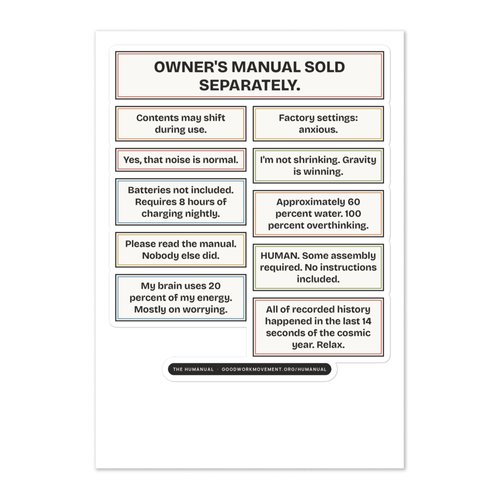 Sticker sheet$10
Printed on demand by Printful, one at a time.