

3 The Humanual · Volume 3 of 5 · the series
The Passengers
The owner’s manual for other people.
Other people are a lot. Here is how they work.

- 258 pages14 chapters and 2 appendices
- Three editionsPaperback $19.99 · Hardcover $29.99 · Ebook $9.99
- Out nowGood Work Press · 5.5 × 8.5 in
- ISBN979-8-952870-07-9 (paperback)

About this volume
Attachment, conversation, conflict, love, friendship, family and grief
You are a social animal. This was not optional. You arrived pre-wired to attach to other humans, to be shaped by them, to need them, and to find them absolutely baffling.
This volume is about everyone else. The original wiring that still runs in the background. The impossible art of communication. The drug called love. The first country you were ever a citizen of, which is your family. Friendship, boundaries, and the cost of caring, which is grief. Then the herd, the water of culture you cannot see, the predators who exploit social wiring on purpose, and the construction of relationships that actually work.
Fact-checked, honest about what psychology has failed to replicate, and finished with scripts you can actually use.
Read the opening
Chapter 1, as it begins
Chapter 1
The Original Wiring
Other People and What to Do About Them
Here is something that will either fascinate or horrify you, depending on your temperament and your relationship history.
Your entire adult approach to love, trust, intimacy, and emotional connection (the way you behave when someone gets close to you, the way you react when they pull away, the specific and remarkably consistent set of things you do when a relationship gets serious enough to actually matter) was largely determined by what happened between you and your primary caregiver during the first eighteen months of your life. A period you cannot remember. Events you have no conscious access to. Interactions that occurred when your most sophisticated communication strategy was screaming until someone addressed the situation, which, now that we mention it, remains the conflict resolution approach of a surprising number of adults.
You did not choose this wiring. You were not consulted. You were, at the time, primarily occupied with learning to focus your eyes and working out what hands were for. And yet the relational code that was written during this period, by a caregiver who was themselves running code written by their caregiver, who was running code written by theirs, in a chain of imperfect emotional programming that stretches back to the Pleistocene, is still executing in your nervous system right now, shaping your romantic choices, your friendships, your arguments, your capacity for trust, and your specific, personal, deeply inconvenient way of ruining things that are going well.
This is attachment theory. It is one of the most extensively researched frameworks in developmental psychology. It has been validated across cultures, replicated across decades, and confirmed by neuroimaging studies that show attachment patterns literally wired into the architecture of the brain. It is also, from a comedic standpoint, one of the richest topics in all of human science, because it means that the reason you cannot stop texting someone who has not replied in four hours, or the reason you feel an overpowering urge to emotionally withdraw the moment someone says “I love you,” or the reason you simultaneously crave closeness and are terrified by it, is not because you are uniquely broken. It is because a baby got a particular kind of care from a particular kind of caregiver, and the baby was you, and the code has been running ever since.
From the book
Frequently Panicked Questions
Every chapter ends with the questions people are too embarrassed or too frightened to ask out loud. These are from Chapter 1.
I just read about the four styles and I think I am all of them. Is that possible?
Not simultaneously, no. But attachment can vary somewhat across different types of relationships, and most people are not a pure type. You may be predominantly secure in friendships but anxious in romantic relationships, or avoidant with family but more open with close friends. Context matters. Stress matters. The specific dynamics of each relationship matter. What you are looking for is the dominant tendency, the one that shows up most reliably when the emotional stakes are high. That said, if you genuinely recognize yourself in all four descriptions with equal intensity, it is worth exploring this with a professional, because it may indicate a disorganized style that shifts between strategies.
My partner is avoidant and it is making me anxious. Or I was always anxious and that is why they are avoidant. Which came first?
Both, probably. Anxious and avoidant partners tend to amplify each other in a feedback loop that can feel as if the relationship itself is the problem, when what is actually happening is that two nervous systems with complementary sensitivities are triggering each other’s oldest and least helpful code. This is not about blame. It is about recognition. Once both partners can see the dance (“I am pursuing because my system says you are withdrawing; you are withdrawing because my pursuing feels overwhelming”), it becomes something you can work with rather than something that is happening to you.
Is it too late to change my attachment style? I am forty-seven.
It is not too late. The research on earned security includes participants across the full adult lifespan. Neuroplasticity does not expire at thirty, however much your knees may suggest otherwise. The wiring is harder to change than it was at eighteen months, because the grooves are deeper and the system has had decades of practice. But “harder” is not “impossible.” Consistent, secure relational experiences, whether from a partner, a therapist, or a close friend, continue to update the model at any age. The fact that you are asking the question at forty-seven rather than at twenty-two does not mean you are too late. It means you are starting with forty-seven years of data about your own tendencies, which is, in a real sense, an advantage.
I think I have disorganized attachment. Am I a lost cause?
You are the opposite of a lost cause. Disorganized attachment is the style most strongly associated with early relational trauma, and it is also the style that shows the most significant improvement with therapeutic intervention, because the tendencies, once made conscious and understood, can be worked with directly. The disorganized system was never given a coherent strategy. Therapy provides one. This is not a small thing. It is, for many people, the single most transformative experience of their lives. You are not a lost cause. You are a system that was given contradictory instructions and did the best it could with them. You can learn new instructions.
Why does texting make my attachment stuff so much worse?
Because digital communication is a near-perfect anxiety-amplification device for attachment systems. Text messages provide no tone, no facial expression, no body language, none of the social cues that your attachment system relies on to assess safety. A delayed reply could mean your partner is in a meeting. It could also mean, according to your nervous system (which is not known for its measured analysis of ambiguous situations), that they have lost interest, are with someone else, or have ceased to care about your existence entirely. The anxious system fills the information void with its worst-case scenarios. The avoidant system uses the distance of texting to maintain emotional distance it could not maintain in person. And everyone involved is interpreting the same three words through the lens of their own attachment model, which is why “sounds good” can be read as agreement, dismissal, enthusiasm, or passive aggression depending entirely on the reader’s wiring. The practical advice is simple: when the emotional stakes are high, use your voice. Ideally, your face. Your attachment system was designed for in-person interaction. It does not perform well on a platform that strips out 90 percent of the relevant data.
Read all 35 Frequently Panicked Questions from this volume
Text from the first edition. General information with jokes in it, not medical, psychological, legal or financial advice.
Contents
14 chapters and 2 appendices
- The Original WiringOther People and What to Do About Them
- The Impossible ArtCommunication
- When Worlds CollideConflict
- The DrugLove
- The Elephant in the RoomSex
- The First CountryFamily
- The Unpaid RelationshipFriendship
- The Invisible FenceBoundaries, Self-Worth, and the Relationship You Have With Yourself
- The Cost of CaringGrief, Loss, Forgiveness, and the Art of Letting Go
- The HerdGroup Dynamics, Belonging, and Why You Agree With People You Just Met
- The WaterCulture, Norms, and the Invisible Forces That Tell You How to Be a Person
- The PredatorsPower, Manipulation, and the Weaponization of Your Social Instincts
- The ConstructionHow to Deliberately Build the Good Stuff
- The BridgeFrom People to Systems
- Appendix AThe Relationship Emergency Reference
- Appendix B“Is This Normal?” A Relationship Self-Assessment Guide
Formats and prices
Where to get it
On sale now in paperback, hardcover and ebook. Buy from any of these shops, or ask your local bookshop to order it by ISBN.
- Paperback$19.99 · 258 pp
ISBN 979-8-952870-07-9Buy on Amazon - Hardcover$29.99 · case laminate
ISBN 979-8-952870-06-2Buy on Amazon - Ebook$9.99 · EPUB and Kindle
ISBN 979-8-952870-08-6Buy on Amazon
The other four
The Humanual is five volumes. Each stands alone.
 1. The HardwareYour Body
 2. The Operating SystemYour Mind
 4. The MapYour World
 5. The CompassYour Meaning
All five volumes, ISBNs and the launch note → · The Toolkit: the practical pages, kept current →
Merchandise. We apologize.
Factory labels for the unit
Shirts, a hat, mugs and stickers that say what the books say, out loud, in public. Every fact on them was checked.
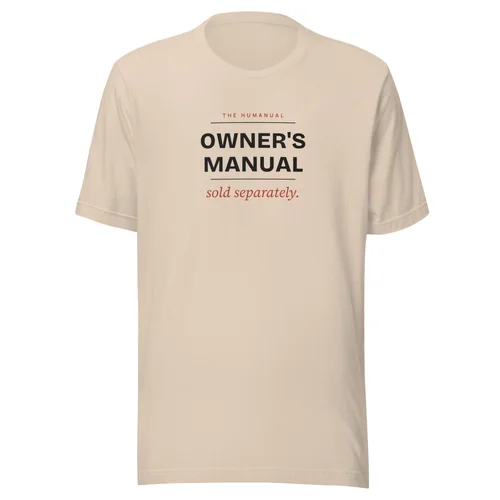 Owner's Manual tee$29
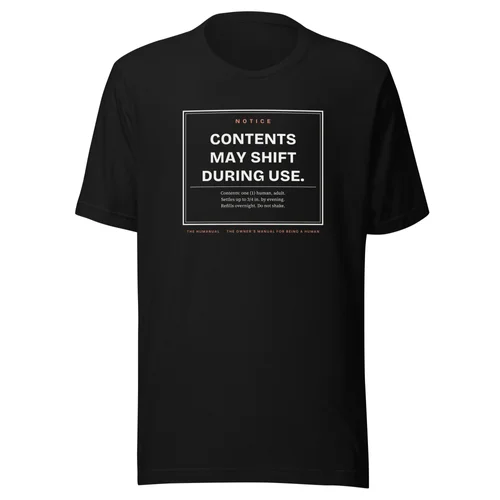 Contents May Shift tee$29
 Owner's Manual dad hat$30
 Gravity mug$24
 FPQ mug$24
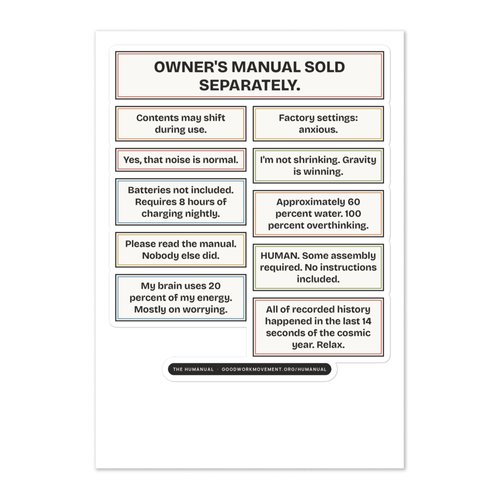 Sticker sheet$10
Printed on demand by Printful, one at a time.